Deprecated: Automatic conversion of false to array is deprecated in /home/ki449515/public_html/wp-content/themes/thefox/includes/zilla-likes/zilla-likes.php on line 212
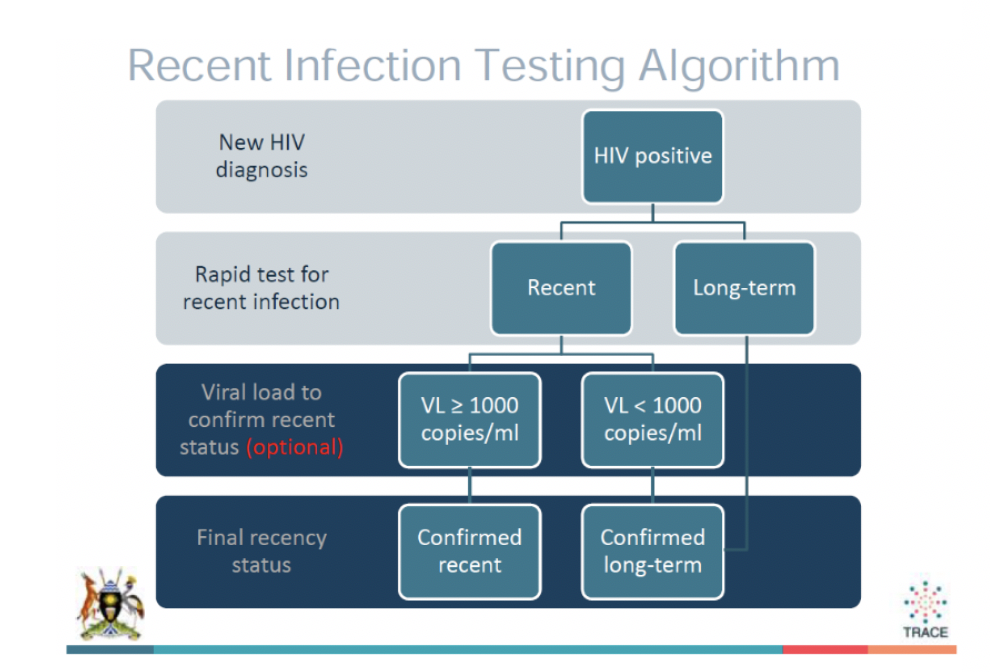 In Uganda HIV diagnosis will be done using the recommended national algorithm after which all newly diagnosed HIV Positive clients will be differentiated into Recent and Long-Term Infections using a rapid testing kit called Asante.
Rapid tests for recent infection (RTRI) pave the way for a recent infection surveillance system as part of routine HIV Testing Services (HTS) to detect and characterise recent infection among newly diagnosed HIV cases in persons aged 15 years and above. As countries move closer to reaching epidemic control, real-time monitoring of recent HIV infections will allow target public health response to sub-populations and locations where high levels of transmission may be occurring. In particular recent infection surveillance will help to:
- Describe trends of recent and long-term infections
- Identify risk factors
- Map hot spots
- Investigate transmission clusters
- Target testing and prevention services
National Training of Trainers
METS in partnership with MoH organised a national Training of Trainers (ToT) on 8-12 July 2019 to:
▷Practical exercises conducting the rapid test for recent infection and data entry
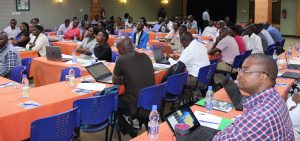
Participants at the National ToT
During the opening ceremony of the ToT, Dr. Wilford Kirungi from Ministry of Health noted that the ministry regarded the training as a critical step in epidermic control considering that it supports the last leg in the control efforts. He further noted that unique approaches, new energies and initiatives were required to achieve the last of the 90-90-90 goals. “Over 80% of clients have been diagnosed and enrolled while over 75% of those enrolled have attained viral suppression while 50% of the male population have been circumcised. This program will help the Ministry to know who is being infected (male or females), which parts of the country these infections are taking place, what age groups are most affected and what behavioural practices are increasing infections,” Dr. Kirungi added.
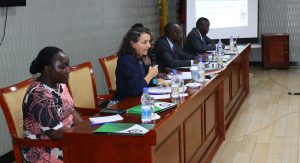
UCSF’s Rachel King emphasising the fact that the participants were tasked with being ambassadors of the training as they carried the responsibility of training their colleagues that were unable to come for the training across the country
In her remarks, METS Program Manager Evelyn Akello noted that METS role in this program included provision of technical assistance in training and mentoring health workers, strengthening information management systems, ensuring data use for practice improvement, inform public health responses as well as procurement of the kits.
Mary Naluguza from CDC called the attention of participants to the key issues of the training which were counselling, testing, data management and reporting as these were to support programmatic decisions across the country in epidermic control.
The ToT was attended by representatives from MoH, CDC, UCSF, Baylor Uganda , RHSP, IDI, MUWRP, RHITES-N, UNHLS, UVRI, EGPAF, District Health Teams
Implementation Plan
During implementation,
- Recency will be integrated into HTS and case-based surveillance through UgandaEMR (HMIS form 055b)
- Recency testing will be done at facility during routine HTS
- Client will provide a written consent with no return of results
- Plasma samples will be sent to UVRI for additional testing and storage in first six months, viral load for quality assurance to inform continued VL testing
- Data will be used for surveillance and public health response
Roll Out Plan
We plan to roll out in a phased approach as highlighted below;
Phase 1 (FY19):35 facilities in five districts in Mid-Western Region (Kabarole, Bunyangabo, Kamwenge, Hoima, and Kikuube), Mbarara, Kampala, and Wakiso where the UgandaEMR is functional.
Phase 2 (FY20):Scale nationally starting with high-volume facilities that have functional EMR systems.
Phase 3:Integration into the national HIV testing strategy, policy, and algorithm
Article by Dr. Godfrey Timbihurira and Nancy Karunganwa
]]>Deprecated: Automatic conversion of false to array is deprecated in /home/ki449515/public_html/wp-content/themes/thefox/includes/zilla-likes/zilla-likes.php on line 212
]]>
Deprecated: Automatic conversion of false to array is deprecated in /home/ki449515/public_html/wp-content/themes/thefox/includes/zilla-likes/zilla-likes.php on line 212
Deprecated: Automatic conversion of false to array is deprecated in /home/ki449515/public_html/wp-content/themes/thefox/includes/zilla-likes/zilla-likes.php on line 212
Deprecated: Automatic conversion of false to array is deprecated in /home/ki449515/public_html/wp-content/themes/thefox/includes/zilla-likes/zilla-likes.php on line 212
Different updated HMIS tools (forms, registers, etc.) were integrated and reports generated. The HMIS project in close collaboration with Ministry of Health also was involved in the organization of the International OpenMRS implementers’ conference to be hosted in Uganda. A series of planning meetings were conducted.
Participants include IT and M&E staff from various CDC and USAID supported Implementing Partners, Districts Bio-Statisticians, HMIS Focal Persons, MoH Division of Health Information and AIDS Control Programme.
The main objective of the workshop was to provide participants with practical hands on training on the updated UgandaEMR system. Specifically, the training sought to; Build capacity to upgrade the existing OpenMRS Installations (1.6.3 to 1.11.6), Give technical guidance on troubleshooting the new features and functionalities of UgandaEMR and to Provide training on report generation and data use.
This training was made a reality with additional support from WHO, MEEP and MJAP.
]]>Deprecated: Automatic conversion of false to array is deprecated in /home/ki449515/public_html/wp-content/themes/thefox/includes/zilla-likes/zilla-likes.php on line 212
MakSPH was funded by President’s Emergency Plan for AIDS Relief (PEPFAR)-USA through the Centers for Diseases Control (CDC) to implement a five-year Monitoring and Evaluation Technical Support (METS) program in Uganda. The five-year program (2015-2020) seeks to promote evidence-based decision-making for an AIDS free generation by supporting the alignment of the USG supported Monitoring Evaluation and Reporting systems with the national M&E framework resulting into a fully functional one M&E system. The Program will work to strengthen capabilities of the Ministry of Health (MOH) and District Health Teams (DHTS) to conduct Monitoring and Evaluation (M&E) of the HIV program, strengthen District Led (HIV) Programming (DLP); conduct Population Case-Based Surveillance, and strengthen the Ministry of Health (MOH) – owned National Health Management Information System (HMIS).
In his remarks, the Principal Investigator Professor William Bazeyo noted that this was a promising effort that needed continued support. He strongly pointed out that with the necessary support from the various stakeholders, the Program would not fail in their efforts towards the fight against HIV in Uganda. He thanked the CDC for their continued support towards HIV and AIDS and specifically to METS. He further noted that the Makerere University School of Public Health was well place and equipped to manage the task at hand. This he based on the fact that MakSPH was able to win a competitive grant worth $35 million to help strengthen Monitoring and Evaluation, disease surveillance, strengthening the capabilities of District Health Teams in order to manage the HIV response.
The Director General of Health Services, Dr. Ruth Aceng noted that Uganda had made significant progress in strengthening national M&E systems to be able to provide information for the national Public Health Response through dialogue and advocacy. She lay emphasis on the need for good information generated by M&E systems and programs because it is critical in promoting efficiency of public health programs. She noted that the Ministry of Health had harmonized reporting through the national HMIS and DHIS2 System and all stakeholders were being urged to contribute towards strengthening this ‘one national reporting system’ and use the system to track progress in the health outcomes. She applauded METS’ efforts to improve the quality of the data collected as this was a challenge that was likely to stunt the purpose of data collection. She pledged the Ministry’s continued support of such projects.
Dr. Steven Wiersma, the CDC-Uganda Country Director in particular appreciated the use of the Case Based Surveillance strategy which would go a long way to track the epidemic in the Country. He further appreciated the real time monitoring of Mother-Child Transmission data which is collected from live feeds hence enabling easy tracking and monitoring. He noted that the CDC had approved additional funding for this particular project.
The Minister of Health Dr. Tumwesigye commended the use of the finger print technology to capture data of persons on ARVs as this innovation gives the M&E efforts an edge. This, he said, is because the data for; those on medication; where patients are getting treatment, how long they had been on the treatment among other advantages; will go a long way in stream lining the available information about persons living with HIV/AIDS. Additional advantages of the alignment of data for HIV is that more victims will be able to access treatment and the Medical stores would reliably give accountability of the provided drugs. He hoped that these efforts and the lessons learned would then be linked to the government system which has a unique identifier – the National Identification Number (NIN). He visualized that when these efforts were to be harmonized, Uganda would be able to characterize the HIV epidemic in real terms – real numbers without duplicates; and therefore be able to track clients using the available technologies.
During the launch, the iMAP mobile based application was launched. The app will capture GPS coordinates for both District Health Offices, Headquarters and the available health facilities in Uganda hence being able to create a directory for all health facilities in the country.
Article by METS Communication Office
]]>