M&E Project
The M&E project (also known as Program Area A) is mandated to contribute to the establishment and strengthening of the national HIV M&E system. This is done through reinforcing the national, district and health facility capabilities in M&E and Quality Improvement for an efficient and effective public health response to the HIV epidemic. The overall project purpose is to promote evidence-based decision-making for an AIDS free generation by supporting the alignment of the USG supported Monitoring Evaluation and Reporting systems with the national M&E framework resulting into a fully functional one M&E system. The specific objectives are:
- To build M&E capacity of District Health Teams and facilities to effectively plan, manage and report timely, consistent, complete and valid data for HIV programs.
- To strengthen CQI approaches for the continuum of response including HCT, SMC PMTCT, ART, HIV care and support in 48 districts.
- To support evidence-based policy development and advocacy for HIV programs among senior government officials at national and district levels
In line with the PEPFAR strategies and principles of ensuring cost-efficiency and fostering ownership and sustainability of project activities, the M&E project employs the following strategies: i) integration, ii) promoting use of burden tables iii) promoting gender-centered approach and iv) capacity building that includes quality improvement (Figure 1). In addition, the project works in close collaboration with the Ministry of Health (MoH), District Local Governments, and district-level Implementing Partners (IPs) with complementary strengths. At national level (MoH), METS closely works with the relevant technical working groups of the AIDS Control Program (ACP). At district level, the District Health Officer (DHO) is the focal person for the project. The District Health Teams (under the office of the DHO) cascade the project activities to the health facilities
Objective 1. Build M&E capacity for DHTs and health facilities
M&E capacity for DHTs
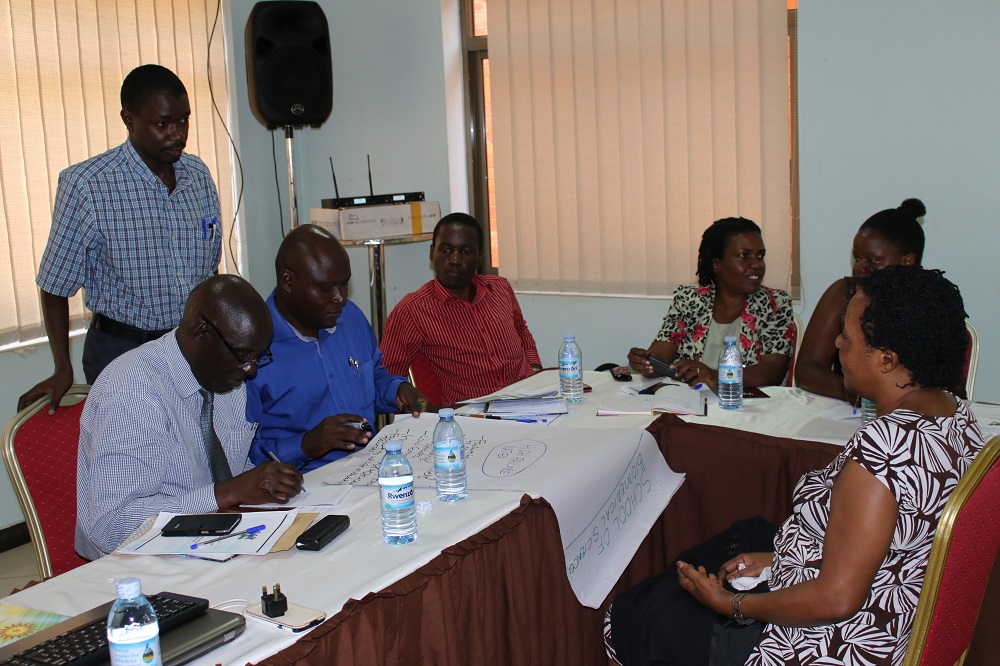
In order to reinforce capacity for M&E among DHTs, METS, in collaboration with the MakSPH/CDC HIV/AIDS fellowship program, designed a short-term (3-6 month) M&E fellowship program for district biostatisticians and HMIS focal persons. The fellowship training is aimed at improving M&E knowledge among district Biostatisticians and HMIS focal persons to be able to collect, collate, analyze, present, disseminate and utilize strategic information for informed decision making and planning at district and health facility levels. In addition, the fellows are expected to design M&E projects for addressing critical M&E gaps in their districts. In order to achieve this, two modules were adopted: i) M&E and ii) data management and analysis. Both modules consist of a 1 week long face to face session with the fellows during which power point presentations are made and question-and-answer sessions, discussions and group work are conducted. In addition, the M&E fellows are guided to develop M&E projects to address critical M&E gaps identified during the training. The M&E projects adopt the Plan-Do-Study-Act (PDSA) approach to quality improvement and mainly focus on program planning, data quality and use
Currently, a total of 104 fellows for 52 districts for have been enrolled in the program and are are different phases of project implementation.
M&E capacity at health facilities
At health facility level, the M&E project supports data management, quality and use trainings for health facility staff. The trainings are aimed at increasing the numbers of facilities and implementing partners reporting timely, consistent, complete and valid HIV data through the district and national reporting system. The trainings target health facility in-charges and Health Information Assistants (HIAs). The trainings cover a number of topics including (i) medical records management (storage, retrieval), (ii) review of district performance (timeliness and completeness) (iii) overview of key HIV data collection tools at the facilities (iv) compilation of reports (timeliness, accuracy and completeness) and (v) data presentation, interpretation and use for decision-making. In an effort to foster ownership and sustainability, the district biostatisticians and HMIS focal persons facilitate the trainings.
Overall, a total of 772 health facility in-charges and HIAs from 388 facilities in the 15 districts were trained.
In addition to the didactic data management trainings for improved quality of data for HIV/AIDS programs, METS supports periodic joint Data Quality Assessment (DQAs) to examine the quality of data generated at health facilities in order to establish a benchmark upon which interventions for improved data quality can be measured. During the DQAs, the data management and reporting systems at the health facilities are assessed. Furthermore, data on a specified set of indicators for a given review period is verified. At each of the health facilities assessed, specific action plans to address the identified gaps are developed and shared with key stakeholders including the DHT members and district-level Implementing Partners (IPs).
To-date, 2 DQAs (baseline DQA conducted in December 2015 and a follow-up DQA conducted June 2016) have been supported by the project. The findings of the follow-up DQA have indicated significant improvements in the quality of data for HIV/AIDS programs.
Objective 2: Strengthening Quality Improvement (QI) along the Continuum of Response (COR) to HIV/AIDS
In line with the new PEPAR guidelines which prescribe a continuum of response (COR) for maximizing health outcomes through decreasing HIV transmission, slowing down disease progress and improving the sense of well-being, METS supports districts and health facilities to institutionalize QI interventions along the COR to HIV/AIDS which includes HCT, SMC, PMTCT, ART, care and support services. The QI interventions are designed to bolster identification of HIV positive individuals, enrollment and early initiation of HIV-infected persons in care, treatment and support as well as increase retention in care and adherence to treatment. To achieve the above, METS adopted a multi-pronged capacity building model for integrating QI activities in the COR
- Baseline QI assessments enable to establish baseline performance with regard to national and PEPFAR standards upon which QI interventions are developed and improvements measured.
- Training of health care teams, DHTs and IPs in CQI approaches using the MoH national CQI curriculum. During the trainings, the quality improvement gaps identified inform the development of site-specific action plans and CQI projects.
- On-site coaching and mentoring: these are conducted in collaboration with MoH and the respective IPs as a post-training follow-up to monitor progress in implementation of CQI interventions for quality services.
- Re-assessments aimed at measuring improvements in service quality following implementation of the QI action plans and projects.
- Learning sessions for trained CQI teams to provide a platform for the trained teams for sharing experiences, lessons learnt and challenges.
To-date, a total of 332 staff from 57 CDC-supported SMC sites (Figure 2) have been trained in QI approaches.
In addition, a total of 979 staff from 279 health facilities in 15 districts were trained in QI approaches for ART/PMTCT services.